


It’s performance review season, time to write self-appraisals.
One year, one of my best product people wrote a self-appraisal that opened with “Shipped onboarding flow.” What she didn’t mention: she navigated three competing stakeholder priorities, translated technical debt into business risk for execs, and found a solution that served engineering velocity AND customer activation AND sales enablement.
Luckily for her, I knew all this. And she submitted early enough for me to send it back with coaching: “Rewrite this so it shows the strategic thinking, not just the task completion.”
She rewrote it. I took the new version to our calibration meeting where we decided on promotions. She got hers.
I’ve watched this pattern play out dozens of times. Talented senior product people undersell their accomplishments because they don’t know how to articulate strategic thinking. They do the work but just don’t document it in ways that show pattern recognition, multi-stakeholder strategy, or adaptive decision-making.
And when performance review time comes, their managers describe them as “solid executors who ship features” instead of “strategic leaders who see around corners.”
The Problem Isn’t the Work—It’s How You Frame It
Most well know PM advice comes from Big Tech where resources are less constrained and leadership has already established clear success metrics that make sense for companies at that size and scale. But when you who work in what I call the “messy middle” on resource-constrained teams, environments where every feature needs to serve multiple objectives simultaneously, it’s particularly important to frame one’s contribution thoughtfully.
You’re making high-stakes decisions with incomplete information. You’re navigating competing stakeholder priorities. You’re finding creative solutions when you can’t just “throw resources at it.” That’s strategic work.
But if you describe it as “shipped feature X” or “communicated with stakeholders,” your manager won’t know how to advocate for you.
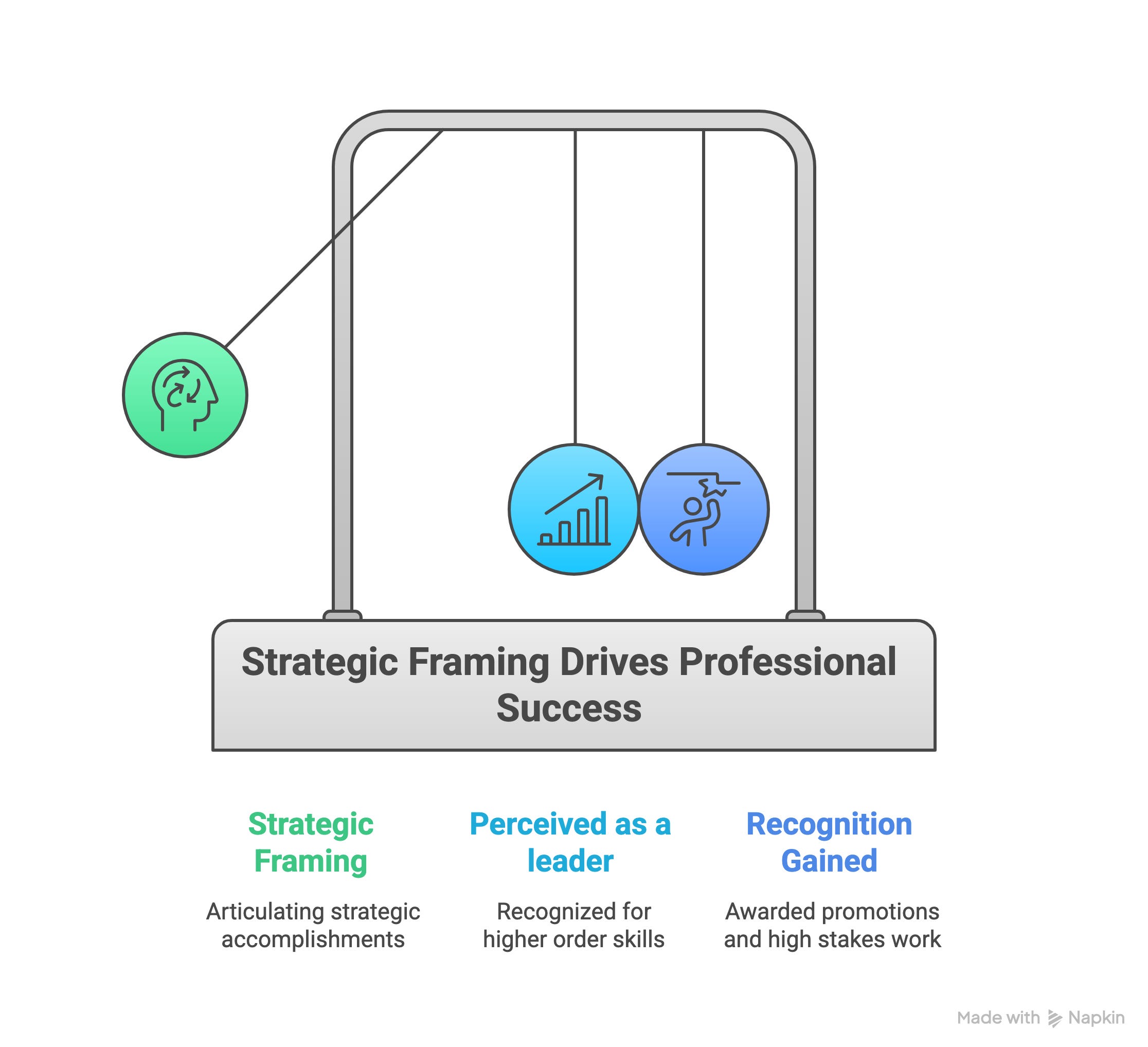
Over the years, I developed five frameworks to help product people document the strategic thinking behind their work. Not the tasks they completed but the capabilities they demonstrated.
These are the things that separate senior product leaders from the rest. And they’re exactly what your manager needs to justify a promotion.
Here’s what to capture and how to frame, so your performance review reflects your strategic approach.
1. The Multi-Stakeholder Win
What most PMs write: “Shipped new onboarding flow. Increased registration by 12%.”
What strategic PMs document:
“Redesigned onboarding flow to solve three problems simultaneously:
Customer: Cut onboarding steps from 8 to 3, improving mobile registration rates
Business: Created foundation for international expansion (internationalization and localization)
Engineering: Reduced technical debt by sunsetting legacy code”
See the difference? The first version describes task completion. The second describes strategic thinking. One feature serving multiple objectives is the ultimate “messy middle” PM skill. It’s important to explicitly articulate it.
How to document this:
Keep a running doc throughout the review period. Every time you ship something, capture:
Customer win: What pain point did this address?
Business win: What metric did this move or what strategic option did it create?
Engineering win: What constraint or technical problem did it solve?
Add to it weekly. By review time, you’ll have a portfolio of strategic thinking, not just a list of launched features.
This is pattern recognition in action: seeing opportunities where adjacent pieces (technology capabilities, customer behaviors, business constraints) fit together into solutions that create cascading value across multiple stakeholders.
2. Translation Moments Over Task Lists
What most PMs write: “Communicated with stakeholders about roadmap changes.”
What strategic PMs document:
“Translated technical debt into business risk:
Engineering said: ‘Our test coverage is at 40% and the codebase is fragile’
I reframed for exec team: ‘Every new feature now takes 2x longer to ship and carries 30% risk of customer-facing bugs. We’re trading speed today for compounding slowness tomorrow.’
Result: Got 2 sprint cycles for refactoring approved.”
This is strategic communication—the skill that actually gets you promoted. You’re not just moving information around. You’re translating complexity into clarity for different audiences. You’re framing technical realities in terms of business outcomes. You’re helping executives understand why something matters.
Most PMs do this in the moment and forget about it by review time.
How to document this:
Capture 3-5 translation moments throughout the year:
Situation: What needed to be communicated?
Technical reality: What did engineering/design/data actually say?
How you reframed it: What language did you use for this specific audience?
Why it worked: What made this land?
Outcome: What decision was made, what alignment was gained, what resource was approved?
Each one proves you can operate at the strategic level—connecting technical complexity to business value in ways that get things unstuck.
3. The “I Changed My Mind Because...” Collection
This one feels counter-intuitive. But it’s powerful.
What most PMs hide: Times they changed direction, killed features, or reversed decisions. They see it as weakness.
What strategic PMs highlight:
“Q2 Planning: I Changed My Mind on Notifications Strategy
Originally proposed: Push notifications for every user action
Three weeks in, I killed it based on:
User research showing notification fatigue in target segment
Engineering feedback that the backend wouldn’t scale to our growth projections
Support data revealing our users valued ‘calm’ product experience
Pivoted to: Smart digest (daily summary) + critical-only real-time alerts
Result: 40% better engagement than original plan would have achieved
What this showed: I optimized for outcomes over being right. I incorporated feedback fast. I didn’t fall in love with my first idea.”
Changing your mind based on new information isn’t weakness. It’s judgment.
It shows you’re not attached to ego, you’re attached to impact. It demonstrates adaptive thinking—a capability that’s critical when you’re operating under uncertainty.
How to document this:
Keep 2-3 examples ready:
Decision: What did you originally propose?
New information: What data or feedback emerged?
Why you changed course: What was your reasoning?
New approach: What did you do instead?
Outcome: Why was the pivot right?
Learning: What did this reveal about your strategic thinking?
“Strong opinions, loosely held” is a key criterion for promotion to senior roles. This framework proves you have it.
4. Product Decisions Under Uncertainty
What most PMs write: “Made decision to deprioritize Feature X.”
What strategic PMs document:
“Decision: Deprioritized Social Sharing Feature
What I knew at decision time:
60% of user interviews mentioned wanting it
Engineering estimate: 8 weeks
We had 6 weeks until competitor launched similar feature
Analytics showed only 12% of users completed current sharing flow
What I didn’t know:
Whether faster launch would actually matter competitively
If interview feedback would translate to actual usage
The constraint that shaped my call:
Shipping fast but broken would hurt brand trust more than being second
Our users valued reliability over novelty (based on churn analysis)
My decision:
Deprioritize social sharing
Ship performance improvements instead
Let competitor go first, learn from their mistakes
What happened:
Competitor’s version attracted particularly vocal criticism, flooded their support
Our version (shipped 2 months later) had 31% adoption because we learned from their UX failures
Performance improvements drove our best NPS quarter
What I’d do differently with perfect information:
Still the same call. Speed without quality doesn’t serve our users.”
This is critical because most performance reviews judge decisions with hindsight bias. But that’s not how strategic thinking works. You made a decision with incomplete information, under real constraints, optimizing for multiple objectives. This framework shows your reasoning at decision time, which is what actually matters.
How to document this:
Pick 1-2 big decisions from the review period:
Decision: What did you choose?
What you knew: What data was available?
What you didn’t know: What uncertainty did you face?
Key constraint: What shaped your call?
Your reasoning: Why did you choose this path?
Outcome: What actually happened?
Hindsight: What would you do with perfect information?
This reframes “mistakes” as strategic thinking under real-world conditions. It shows you can operate effectively when you don’t have all the answers—which is the reality of product leadership.
5. The “Constraint That Made Us Better” Story
What most PMs write: “Worked with limited resources.”
What strategic PMs document:
“How Having No Design Support Made Us Ship Faster
The constraint:
Design team was at capacity for 6 weeks
Feature was needed for customer pilot in 4 weeks
Waiting meant losing $150K pilot opportunity
What I did:
Learned enough Figma to create low-fi mockups
Ran mockups through 8 user tests myself
Partnered with an engineer to iterate directly in code
Used design system components (no custom work)
What happened:
Shipped in 3.5 weeks
Customer pilot converted to $150K annual contract
Learned I could move faster by reducing handoffs
Built stronger engineering partnership through collaboration
The unexpected win:
This became our model for future small bets
We now ship experiments 40% faster using same approach
Design team focuses on high-impact strategic work”
Every PM has resource constraints.
The difference between complaining about constraints and demonstrating strategic thinking is how you frame them.
A constraint became a forcing function. It pushed you to find a creative solution. And that solution created a pattern you could replicate.
How to document this:
Pick one constraint story:
The constraint: What didn’t you have?
The stakes: Why did it matter?
Your approach: How did you work around it?
The outcome: What did you achieve?
The pattern: What did you learn to replicate?
One well-documented constraint story beats ten “I worked hard” statements.
It shows resourcefulness, creativity, and the ability to find solutions when you can’t just throw resources at the problem. That’s exactly what execs want in senior leaders.
Why This Matters Right Now
Your performance review conversation is happening whether you document this stuff or not.
The question is: Will your manager describe you as “a competent PM who ships features” or “a strategic leader who sees around corners and finds solutions where multiple stakeholders win”?
If you don’t capture the strategic thinking behind your work, no one else will.
Your manager sees the features you shipped. They don’t necessarily see the three stakeholder problems you solved simultaneously. They don’t see the moments you translated technical complexity into business language that got resources approved. They don’t see the constraint that forced you to find a better solution.
Here’s what happens if you don’t do this:
You’ll walk into your performance review with a list of shipped features. Your manager will say “great execution” and give you a solid rating. You’ll wonder why you didn’t get promoted when you know you’re doing strategic work. And next year, you’ll have the same conversation.
Here’s what happens if you do this:
You’ll submit a self-appraisal that shows pattern recognition, strategic communication, and adaptive thinking. Your manager will have the language they need to advocate for you. And when the promotion conversation happens, they’ll have concrete examples of why you’re ready.
Start This Week
You don’t need to document everything all at once. Pick one framework from this list. Document one example this week.
Did you ship something that solved problems for multiple stakeholders? That’s Framework #1.
Did you translate something complex into language that got an executive to say yes? That’s Framework #2.
Did you change your mind based on new information? That’s Framework #3.
Did you make a decision under uncertainty? That’s Framework #4.
Did a constraint force you to find a better solution? That’s Framework #5.
Capture it while it’s fresh. Add to your doc weekly.
By performance review time, you’ll have a portfolio that shows the strategic PM you actually are—not just the features you shipped.
Quick question: What’s the biggest challenge you face with self-appraisals? Hit reply and let me know - I read every response and often share insights in future posts.
Want Help With This?
I work with product leaders 1:1 on strategic communication to document and articulate your strategic thinking on a limited basis.
We’ll work through:
Your actual performance review using these frameworks
How to translate product instincts into executive-ready narratives
How to position yourself for the next level
About me: I help product leaders see around corners through pattern recognition, strategic communication, and AI-augmented thinking. I’ve been VP/GM at Vonage, Mapbox, and SiriusXM, and I currently teach AI + Business Communication at Diablo Valley College. I work with product leaders navigating the “messy middle”—resource-constrained environments where every decision needs to serve multiple objectives.