

“Bring your whole self.” “Be real.”
I heard it so many times in my career that I started to practically treat it the way a teen might treat parental advice. Somewhere along the way, “be authentic” became one of the most repeated pieces of career advice we give, especially to people who are told they need more leadership presence. The problem is that it is doing a lot of damage to people’s careers, because we almost never hear that advice caveated with what it does not mean.
Here is the version I embrace: Authenticity is an asset. Authenticity is NOT the same thing as transparency. There is a bright red line.

I was coaching someone who was doing the work of a leader and not being seen as one. She told me how being authentic had worked well for her in her career, until now: brand new leadership came in, she presented the work her team had been doing, which had outsized impact, and yet she had been passed over for promotion twice. Curious, I asked her to present to me, and she said, “The task ahead of us was ambitious. I wasn’t sure if it was doable, but my team was incredible, and in the end they pulled a rabbit out of the hat.” It set off alarm bells for me.
I see this most often in people who are very good at their jobs, yet do not fully believe it. Sometimes it sounds like doubt in oneself; sometimes like handing the team all the credit. Either way, the person deciding the promotion never sees the individual’s own hand in the work. They have learned that being open and honest builds trust, and it does. So in a high-stakes room, when they are warm, real, and unguarded, their doubt comes out along with everything else, and so does the reflex to give the whole win to the team. My coachee thought she was being genuine. What she was actually doing was handing other people a story about their own limitations.
Why it costs so much
Here is what happens on the other side of that disclosure, especially when the listener does not know you well yet:
They become confused and concerned. They have to reconcile two data points: the accomplishments on paper, and the person in front of them saying she is not sure she is good at this. Most people resolve that tension in the least flattering direction, erring on the side of caution. When you express self-doubt, they think, well, she would know. And they conclude that the doubt is the truth and the resume is the exception.
You have colored their read of you, through no fault of your competence, purely through your narrative. A first impression is a small number of strong signals. If one of the loudest is your own uncertainty about your ability, that is what sticks.
The unfortunate thing is that the people most likely to do this are often the ones with the most to be confident about. The self-doubt is not a reflection of their work. It is a habit of mind and speech. But the room cannot see the gap between the habit and the reality. It only hears the words.
And it’s a double bind if you are a woman: women get coached toward warmth and authenticity harder than men and get punished for hedging harder too.
The line that actually matters
Doubt about the work is fair game. Doubt about yourself is not.
“Here is what we have not solved yet, and here is the open risk I am watching” is leadership on display. It shows you see the terrain clearly and you are not spinning. A good senior leader will respect it.
Leading with “I am not sure if there is a better approach” in an attempt to be humble is a whole different thing. That is not clarity about the work. That is a running commentary on your own adequacy, and it belongs in your journal, or in conversation with people who have already earned the full picture of your inner life, not in the meeting where someone is deciding what you are capable of.
Be absolutely real about who you are, what you care about, what drives you, where you want to go, and what you believe about the work. Stop just before you cross into narrating your doubts about yourself.
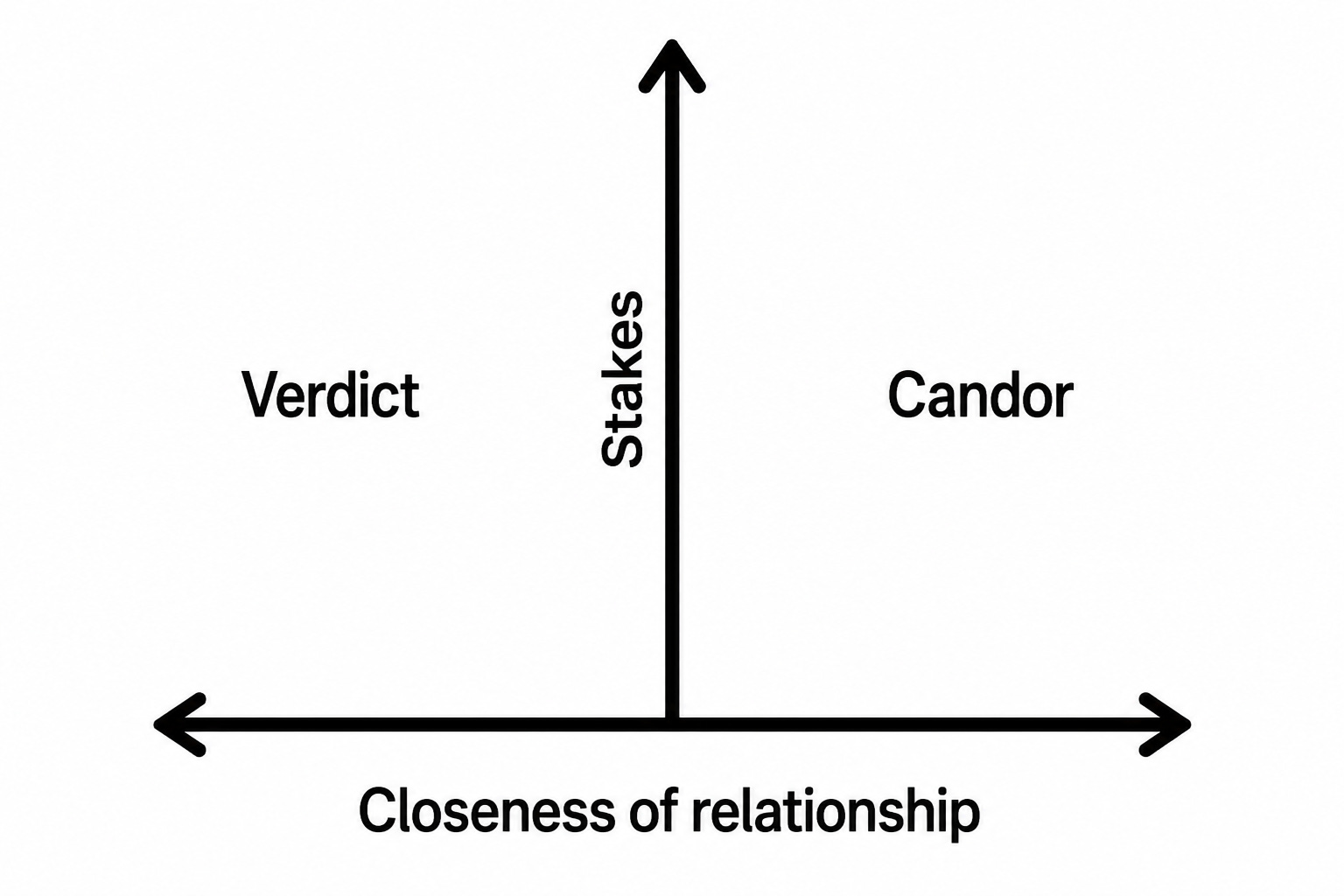
It depends on who is listening. Raw doubt in front of someone who already trusts your work reads as candor. In front of someone still deciding what to make of you, it does something else entirely: it becomes the one hard fact they have, and they build the rest of their read around it.
Confidence you do not have to fake
There is a trap on the other side of this. Being invulnerable or pasted-on confidence you do not feel is a recipe for failure. The people who read a room for a living can feel manufactured certainty in a second. Faking it just gives them a different reason not to trust you.
The real work is to build enough genuine, grounded belief in what you have done that there is simply less doubt to leak in the first place. That is slower and less satisfying than a rule about what not to say, but it is the thing that will hold up against a pressure test. When you actually know the value of your work, when you have looked at it squarely and called it what it is, you stop needing to hedge. Hedging is only necessary to protect yourself from being seen as someone who is overclaiming.
So the practice has two parts. In the short term, catch the phrases. When you hear yourself starting to narrate self-doubt, stop. Say what you actually did instead. In the longer term, do the harder work of believing it, so the catching gets easier because there will be less to catch.
Definitely always be authentic. Just know the difference between being real and being raw, and how well your audience knows you. Share your values, your conviction, and your open questions about the work freely. Keep your doubts about your own worth off the table until you have made them smaller, and let people meet the version of you that the evidence already supports.